


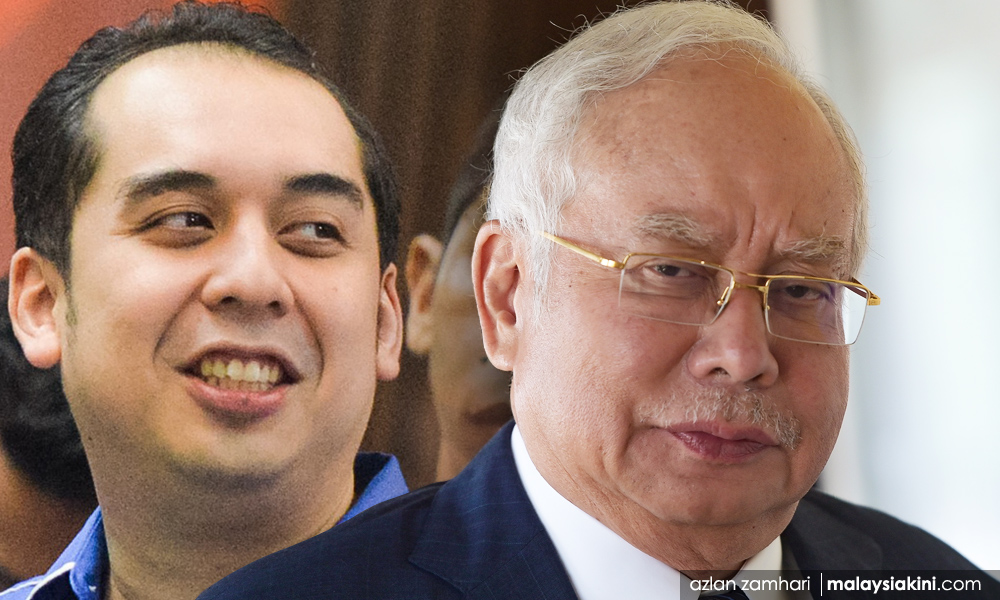

Najib, son get leave to appeal RM1.7b tax bill
Najib Abdul Razak and his son Mohd Nazifuddin can appeal to the Federal Court over a summary judgment entered against them regarding the payment of income tax amounting to RM1.69 billion and RM37.6 million respectively to the Inland Revenue Board (IRB).
This follows a unanimous decision today by a three-member bench led by Chief Justice Tengku Maimun Tuan Mat in granting leave to Najib and Nazufuddin as the applicants to appeal against the Court of Appeal’s decision.
“It is our unanimous decision that...
Najib Abdul Razak and his son Mohd Nazifuddin can appeal to the Federal Court over a summary judgment entered against them regarding the payment of income tax amounting to RM1.69 billion and RM37.6 million respectively to the Inland Revenue Board (IRB).
This follows a unanimous decision today by a three-member bench led by Chief Justice Tengku Maimun Tuan Mat in granting leave to Najib and Nazufuddin as the applicants to appeal against the Court of Appeal’s decision.
“It is our unanimous decision that the requirements of Section 96 (a) and (b) of the Courts of Judicature Act 1964 (CJA) have been met in terms of Enclosure 1 (motion for leave to appeal). Costs in the costs,” said Maimun who presided with Federal Court judges Nallini Pathmanathan and Mary Lim Thiam Suan.
Section 96 (a) and (b) of the CJA stated that leave would only be given by the Federal Court or Court of Appeal in any civil cause or matter involving a question of general principle decided for the first time or a question of importance upon which further argument and a decision of the Federal Court would be to public advantage or from any decision as to the effect of any provision of the Constitution including the validity of any written law relating to any such provision.
The former prime minister and his son are seeking leave to file an appeal against the summary judgment obtained by IRB to recover more than RM1.7 billion in tax arrears from them.

Two separate High Courts had allowed the IRB's applications to enter summary judgment to recover tax arrears of RM1.69 billion from Najib and RM37.6 million from Nazifuddin for the period between 2011 and 2017.
A summary judgment is obtained when the court decides on a case through written submissions without a full trial and calling witnesses.
Both Najib and Nazifuddin lost their appeal in the Court of Appeal on Sept 9, 2021, to set aside the summary judgment.
The appellate court, however, granted the applications by both men to temporarily halt (interim stay) the summary judgment order pending the hearing of their leave to appeal application before the Federal Court.
In civil cases, litigants must first obtain leave before they can proceed with their appeals in the Federal Court.
Earlier, counsel Muhammad Shafee Abdullah, who is representing Najib and Nazifuddin submitted that the IRB’s conduct is bad faith and it is clear that the respondent (IRB) is seeking to bankrupt his clients even before the Special Commissioners of Income Tax can hear the merits of their defence to the additional tax assessments raised against them.
The IRB was represented by IRB’s deputy solicitor Dr Hazlina Hussain while counsel Anand Raj from Malaysia Bar acted as amicus curiae.
Meanwhile, another one of Najib and Nazifuddin's counsels, Wee Yeong Kang, said when contacted they would file a notice of appeal as soon as possible.
- Bernama






Are you sure you want to delete this comment?
This action cannot be undone.